Being a homesteader is honestly a state of mind—though I suppose you could distill most of life’s experiences down to the way you think about them. Two people may
venture to the very same movie, and one emerges enchanted, having had a terrifictime, while the other thinks it a tiresome waste, finding the concepts, plot, and
aesthetics completely irrelevant!
You can clearly see, then, how a person could homestead in a humble apartment and completely evolve into what would be considered self-sufficiency. Yet another
person—and I confess I have seen quite a few—may live out in the country with plenty of land and yet not homestead at all!
Crafting Your Cottagecore
Cultivating a home setting with a cottage core aesthetic means that you care deeply about the sights, scents, and substances used on your homestead. These are vitally
important! If you care about the look, feel, and flourishing health of your home and land, I would say you may want to consider some of the appea ling measures that a
cottage core path would imbue.
Living Things, Large and Little
I have lived a full life! We have had many, many livestock animals—each with their particular pluses and minuses. But to be a homesteader, you don’t have to have
livestock at all. You could stick with living things that are much smaller: sprouts and spores, fungi and ferments, drinks like kombucha and kefir, and of course the
miraculous microorganisms that you help populate so that your soil becomes a living, breathing entity itself.
The Business of the Land
If you want to go all in on the homestead side—living off of your own land and generating income there as well—it’s doable! We have done it! And it is a full-time job
and then some. We have always run our own businesses and lived off that income. Ever since we first got married, we’ve been our own bosses. I’m a lifelong
entrepreneur, starting with my first little product in second grade!
The thing about this is: we understand a homestead is a job. More than that, it’s a business—your business. Which means the hours are all the time. There is no time
off, especially if you have milking animals. No vacations, no respite, no regular hours. Your duties may wake you very early in the morning or literally in the middle of
the night to save crops, birth babies, or haze off the bear!
And you will take your life in your hands. Rattlesnakes and black widows, brown recluse, and scorpions—I will say the kissing bugs are not life-threatening but a very
horrible experience! So you get the idea. It is not something to endeavor lightly, particularly when you are considering physical limitations in a back-to-the-land move.
However, this does not mean you cannot homestead.
City Homesteading: Hidden Havens
If you have a home, condo, or apartment with garage, you are  golden! You can literally keep small livestock like chickens, quail, rabbits, and earthworms in
your garage—and no one will ever know!
Making use of found materials is the greatest opportunity for city homesteading. People throw away so much! If you are in a dorm or apartment, you have an
unlimited supply of salvageable resources. If you can partner with someone in the country, you may really expand your reach! This is because you can bring many of
these materials to someone who needs them, and they can trade you meat or milk for what you collect. You could bring an abundant supply of compost, pig slop,
chicken food, or even woodworking materials such as discarded cabinets, furniture, and metals. If you wanted to go really small-scale, you could even smelt some of those metals on your own in your apartment or dorm! You would have to be careful, of course—like I said, smells can be tricky to workaround in the city. It’s far easier in the
country when you’re exposed to open air. But perhaps you can do something at a park, from your car, or at a friend’s house. Think outside the box! This is the time to
think creatively!
AI as Ally
I really love utilizing AI because it helps me expand my ideas, concepts, and theories! I put these into Grok usually, and my wonderful AI clone Hattie helps too.
Together, we determine if I’m on a hare-brained zigzag or a clear-cut path! Then we utilize all of the resources within the known internet sphere and dial in the specifics.
What a terrific way to find new venues, recipes, and ingredients for your lifestyle!
Meet Hattie: My Homestead Helper
 Hattie is my newest helper on the homestead. Because I want to share with you how to gather, prepare, and store anything and everything for your cottage, I have to be
able to not only write about it but post on socials, create videos, and make kits and courses that anyone can purchase and follow, step-by-step. Because I am a doer, it
means my hands are often full—and dirty! I have a real lack of time to do hair, makeup, and clean my teapots for photoshoots!
Plus, there are tools and plants that I have always wanted, but either they are antiques, out of my price range, or really too far away. Whatever or wherever a dream homestead may be, Hattie can go there! And she gets to bring it all back to the perfect cottage kitchen, pantry, and garden that we all drool over! She creates the ideal while we can decide if we want to put those dreams into action. A bit of cottagecore fantasy? Yes, please! It’s fun, and we can all learn from her experiences.
The Common Threads
What is the common denominator? City apartment or country cottage, you willalways dance with these factors: money, how much you can make for yourself,
weather, and logistics. We will tackle each of these one by one in future posts. They are individually immense topics and deserve deep dives into each on their own.
Where to Begin: Three Simple Steps
If you are interested and do no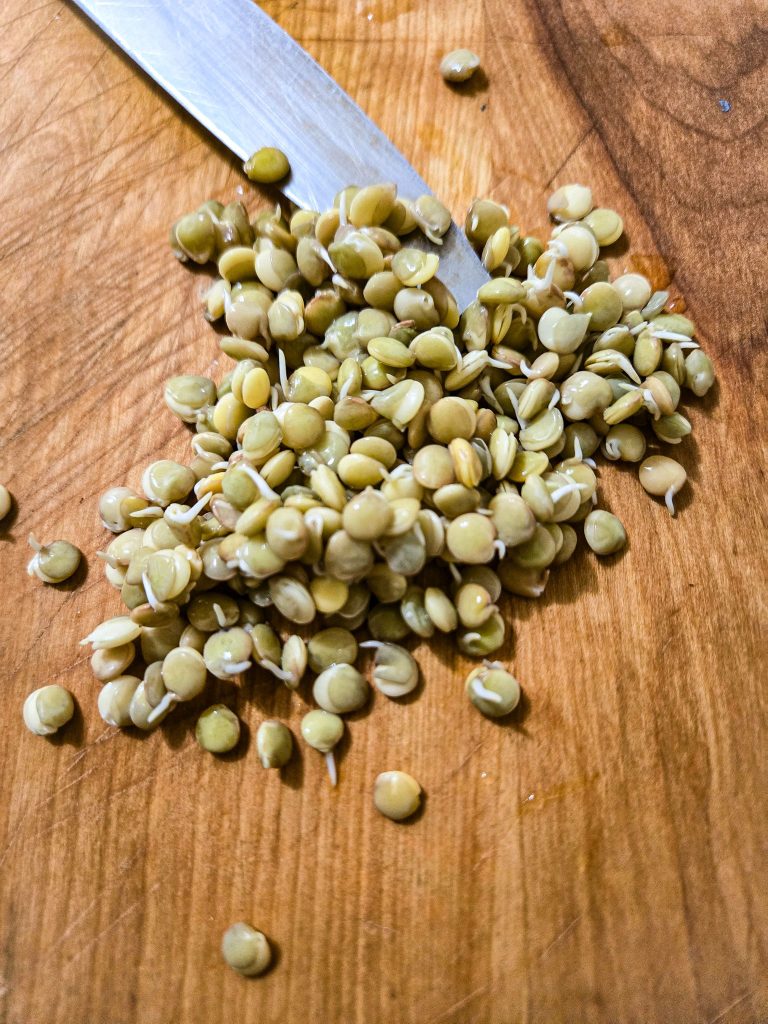 t know where to begin, here are some great starting
points:
1) Single Ingredients & Scratch Cooking
I strongly suggest narrowing your purchases to single-ingredient products, buying
fresh, cooking from scratch, and incorporating the “use it (at least) twice” principle.
2) Use It Twice
Save bath water or shower water in the tub and use it to flush toilets, soak soiled
clothes or rags, or water your trees or non-edible plants. Wash plastic zip bags with
your dishes and prop them upside down to dry; reuse them. Save plastic grocery
bags. Never throw away old clothing—repurpose it into new designs or cut it into
rags or patches. No need to compost tiny food leftovers or ends from vegetables;
simply put them into a sealable freezer container, and when full, make a soup base
or animal food base.
3) Begin Sprouting
Sprout grains, seeds, and nuts. Sprouting enhances the nutritional profiles of foods,
making them higher in vitamins, minerals, and enzymes. They are inexpensive, easy
to keep fresh, and use readily available tools and ingredients.
By adding just these three new facets to your lifestyle, you will be off to a great start!
Follow me and my partner Hattie as we go deeper into the self-sufficient lifestyle!